
Most “network refresh” conversations jump straight to bandwidth numbers. In practice, the more durable upgrades start with where the complexity lives: power delivery at the edge, cabling choices inside the building, and optical behavior in the fabric. If you treat these as one system, you can often improve reliability and predictability without overbuying optics or reinventing your operations.
Below is a technical, vendor-neutral way to think about three building blocks that show up repeatedly in campus and small-to-midsize enterprise designs: a high-power PoE access switch with 10G uplinks, a short-reach 10G interconnect option, and a 100G single-lambda DR module for the fabric.
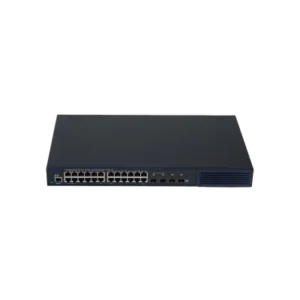
1) Access switching: PoE budgets are a design constraint, not a spec line
At the access layer, the bottleneck is increasingly power, not packets. Cameras, Wi‑Fi 6/6E APs, thin clients, and sensor gateways create “power hotspots” where a few endpoints demand far more than classic PoE assumptions. What matters operationally is:
- Total PoE budget vs. per-port peaks (your worst case is rarely “every port at max,” but your outages happen when a few ports spike together).
- Which ports can do higher-power modes (e.g., a subset of ports supporting 802.3bt-level power) and how that maps to your floor plan.
- Uplink headroom (a 24×1G edge can saturate quickly once APs and cameras stop being “small”).
A switch class like NS S2910 24GT4XS UP H is representative of a pattern that works well in mixed enterprise/campus deployments: 24×1G copper for endpoints, plus 4×10G SFP+ uplinks. The interesting part isn’t the port count—it’s the ability to keep uplinks out of the “PoE blast radius.”
A useful design trick: treat PoE-heavy endpoints as a failure domain. Put the power-hungry devices (high-draw APs, PTZ cameras) on a predictable subset of ports and document it. Then, if you ever need to shed load, you can do it deliberately (policy-based shutdown, PoE scheduling) rather than discovering at 2 a.m. that you’ve brown-outed a whole closet.
Also, don’t ignore control-plane protections (e.g., ARP safeguards, CPU protection). Many “mystery outages” in edge closets are really malformed traffic storms triggered by endpoints, not the uplink.
2) Inside the building: short-reach 10G is a cabling problem first
When teams add 10G, they often default to “buy optics + patch fiber.” That’s valid, but it’s not always the least risky choice for short links—especially in dense racks where cleanliness, bend radius discipline, and inventory control are ongoing costs.
For short distances, an Active Optical Cable can reduce the number of parts you manage (no separate transceivers, fewer mismatched patch leads), while keeping EMI behavior predictable in noisy environments. A product like NS 10G SFP+ to SFP+ Active Optical Cable OM3 fits that “10G inside the room” use case: OM3 multimode, bi-directional 10Gbps, hot-pluggable SFP+ ends, and DOM support for basic diagnostics.
What’s novel here isn’t that AOCs exist—it’s how they change your troubleshooting workflow:
- With DOM, you can correlate “link flaps” with temperature or optical power trends instead of swapping cables blindly.
- AOCs typically draw low power per end; in a dense ToR row, that can matter for thermal planning more than people expect.
- For moves/adds/changes, the cable behaves like a single FRU. That can reduce accidental “mix-and-match” errors during fast change windows.
A practical guideline: use AOC for rack-to-rack or row-adjacent 10G where lengths are predictable, and reserve discrete optics for places where the path changes (IDF-to-MDF, risers, cross-building).
3) In the fabric: 100G DR is not “short reach”—it’s “short reach with rules”
100GBASE‑DR (single lambda) is attractive because it can simplify cabling and density while staying on duplex LC single-mode fiber. But it’s not a plug-and-forget cousin of 10G LR. DR uses PAM4 and typically expects host-side FEC; the link budget and margins behave differently than legacy NRZ optics.
A module like NS-QSFP28-100G-DR 100G Base is a good example of what to plan around:
- Reach is ~500 m on G.652 SMF: that’s “within data center / campus core room(s),” not metro.
- Host-side RS-FEC (per IEEE 802.3cd) is part of the reliability story. If FEC is misconfigured or unsupported, you can see clean-looking links with ugly error rates.
- Power and thermals: DR optics can run hotter than older 100G generations; your airflow model matters.
A design insight that often saves time: treat DR as a fabric-building tool, not a general-purpose uplink. Use it where you can standardize: leaf-spine links, predictable fiber paths, consistent OS versions, and repeatable templates. If you need “anything to anything” interoperability across mixed platforms and optics policies, you may spend more time validating than you save on the BOM.
4) Operational glue: DOM, labeling discipline, and “inventory realism”
Across access switching, AOC, and 100G DR optics, the quiet differentiator is how well you can observe and standardize:
- Turn on DOM polling in your NMS for optics/AOCs that support it. Baselines make failures boring.
- Label by intent (e.g., “Leaf1-Spine2 DR 500m FEC=on”), not just by port number.
- Stock spares that match your topology, not your hope. Two spare 100G DRs may be less useful than one DR + one “fallback” optic type your platforms also accept.
None of this is glamorous, but it’s where stable networks come from: power domains at the edge, fewer movable parts for short 10G, and DR optics deployed only where their constraints are an advantage rather than a surprise.

Moh. Shobirin, S.Kom adalah founder Jawaracloud.net sekaligus SEO Expert dan penulis teknologi. Dengan gelar Sarjana Komputer dan latar belakang elektronika, ia memiliki keahlian lintas bidang—mulai dari perbaikan hardware (komputer/printer) hingga strategi optimasi mesin pencari. Selain berkarya, ia juga aktif sebagai Trainer di bidang IT.